


Blog
Where Is the Best Place to Start on a Paint by Numbers?

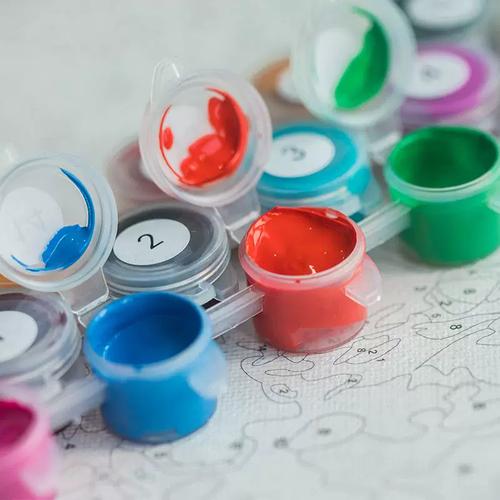
You’ve set up your workspace: the kitchen table is clear, newspaper is down, and your water cup is ready. The canvas is stretched, and the little pots of paint are lined up in order. Now comes the big question every beginner asks: Where should you put your brush first?
Do you start with the tiny details of the eye? Do you tackle the massive background sky? Or do you just go for color number one and work your way up?
While there is no single "law" of paint by numbers, veteran hobbyists and professional artists agree on one principle: You should almost always start at the top and work with the darkest colors first. Here's a detailed strategy to ensure your finished piece looks crisp, clean, and frustration-free.
The "Top Down" Method (Avoid the Smudge)
The most practical reason for choosing a starting point has nothing to do with art theory but everything to do with physics and your shirt sleeve.
Always start in the upper left-hand corner (if you are right-handed) or the upper right-hand corner (if you are left-handed).
Why? Because paint takes time to dry. If you start in the middle or bottom, you will inevitably rest the heel of your hand on wet paint as you reach across the canvas. This leads to two disasters:
-
smear wet blue paint into the pristine white area meant for yellow.
-
Transfer: The wet paint on your hand will pick up pigment and deposit it elsewhere, like an unwanted, muddy fingerprint on a cloud.
When you start at the top and work down, your hand will always rest on a dry or untouched part of the canvas.
The "Dark to Light" Rule
Now that you know where to start on the canvas (the top), let's talk about which colors to use. The golden rule is Darkest First, Lightest Last.
Reason 1: Coverage and Correction
Dark colors like navy blue, deep brown, and black are easy to work with. If you paint a dark area and accidentally go over the line into a pale yellow section, it’s simple to fix. Just let the dark paint dry, then paint the light yellow over the mistake. The dark color won’t show through.
If you do the opposite and paint the pale yellow first, then accidentally get dark blue on it, you might need three coats of yellow to cover the stain.
Reason 2: Depth Perception
Painting dark shadows and backgrounds first helps you see the contrast. As you add mid-tones and then highlights like white, bright yellow, or pale pink, the picture starts to stand out. It’s similar to developing a photo: the dark areas show the structure, and the light colors bring it to life.
Some kits feature a large, solid background—perhaps a vast blue sky or a dark forest silhouette behind the main subject. Many experienced painters advocate for starting with the largest background area.
Pros:
-
Momentum: Knocking out 20% of the painting in one sitting by filling in the sky feels incredibly productive.
-
Layering: This allows you to paint the foreground elements (trees, flowers, faces) over the edge of the background later. This creates a slight overlap that hides the canvas's white line and gives a more seamless, professional finish.
The Numbers Strategy: Should You Go in Order?
No. One of the biggest beginner mistakes is painting all the #1s, then all the #2s, then all the #3s. This sends you zigzagging across the canvas from the top right to the bottom left, then to the middle. You will smear paint everywhere.
Instead, use the "One Pot, One Section" approach:
-
Open one pot of paint (say, Dark Brown #3).
-
Look only at the top quadrant of the canvas.
-
Paint only the #3 spots in that top quadrant.
-
Close the pot.
-
Move to the next color in that same top area.
A Note on Tiny Details
At the end, you’ll probably find a few small spots with tiny numbers you missed. That’s normal. It’s much easier to fill these in with a fine-tip brush at the end than to worry about them while working on the bigger areas.
The Verdict: Your Starting Game Plan
For the best results with less stress, follow these steps during your next painting session:
-
Set up your canvas so you start in the top left corner if you're right-handed, or the top right if you're left-handed.
-
Pick the Color: Choose the darkest color visible in that zone.
-
Go Section by Section: Paint all spots of that dark color within a 4-inch radius before moving on.
-
Progress Downward: As the top dries, slide your hand down, painting the mid-tones, and finally the bright highlights at the very bottom.
If you follow these steps, you’ll spend less time fixing smudges and more time enjoying the relaxing process of painting. Have fun!